
Solvent emissions account for approximately two-thirds of total industrial emissions. Traditional organic solvents are volatile and easily evaporate into the atmosphere, causing many negative impacts, including climate change, reduced urban air quality, and human disease. With the in-depth study of ionic liquids in electrolytic capacitors, researchers can use molecular dynamics simulation methods to predict certain thermodynamic properties of ILs. In recent years, methods to control the thermodynamic physicochemical and mechanical properties of ionic liquids by mixing two electrolytic capacitor ionic liquid have received widespread attention. With the appropriate combination of different ions, electrolytic capacitor ionic liquid can be designed with desired properties. Through theoretical calculations, the optimal structure of the electrolyte can be designed efficiently and rationally, ultimately achieving a significant improvement in the electrochemical performance of the battery. In order to establish the relationship between the structure and properties of ionic liquids in electrolytic capacitors, knowledge about the structure and bonding of ionic liquids is needed. Reliable data. Various computer simulation methods are effective ways to study ionic liquids in electrolytic capacitors. With the exponential growth of computing technology, simulation experiments have become increasingly popular. For example, the properties of many candidates can be estimated and filtered calculated before they are synthesized, which can help determine which candidates are best suited for a given application. Additionally, molecular dynamics simulations can provide insights into the structure and dynamics of specific electrolytic capacitor ionic liquid, both in bulk and near various interfaces. However, this requires a detailed parameterization of the force field used. In contrast, without parameterization, quantum mechanical calculations can quickly explore the application space of ionic liquids in electrolytic capacitors, which is large due to the large number of possible anion-cation combinations.
Fast computational methods are essential for both high-throughput screening and large-scale simulations. These methods can be accurate enough to analyze all physical interactions in electrolytic capacitor ionic liquid. Density functional theory (DFT) methods offer a balance between speed and accuracy. The success of DFT depends on whether the exchange-correlation functional used can adequately describe the system.

1 Density functional theory and its application in the study of ionic liquids for electrolytic capacitors
1.1 Electrolytic Capacitor Ionic Liquid Density Functional Theory
DFT was first applied in the field of quantum mechanics in the early 21st century. Finding the lowest energy point of the system to obtain the equilibrium density distribution of electrons has gradually become the core issue studied by DFT. The theory has been expanded to describe the thermodynamic structure and properties of heterogeneous fluids, that is, the equilibrium density distribution of fluid molecules is obtained by minimizing the free energy of the system. The theory was first applied to the equilibrium gas-liquid interface. In comparison, the local density approximation (LDA) was mostly used in the early stages. LDA is a method to simplify the energy expression of heterogeneous systems. Its main idea is to approximate some local properties of heterogeneous fluids as homogeneous fluids. Through this method, the energy expression of heterogeneous systems will be greatly simplified. Later, Evans constructed a new DFT model by introducing the Percus-Yevick (PY) approximation and calculated the structure and thermodynamic properties of the gas-liquid interface of Lennard-Jones (LJ) fluids at equilibrium. The new DFT model will also be used to study the long-wave behavior of liquid structure factors, spinodal decomposition and other properties.
LDA has good predictive ability when used to describe heterogeneous systems with mild density fluctuations (such as gas-liquid interfaces and heterogeneous systems under the action of gravity fields). However, for heterogeneous systems with violent density fluctuations, obvious deviations or even errors may occur in the prediction, such as the description of fluid structure and properties in confined spaces (slits, solid surfaces, etc.). Therefore, it is necessary to consider introducing other approximate methods. Curtin and Ashcroft adopted a new method to calculate the thermodynamic properties of heterogeneous fluids, namely the introduction of the weighted density approximation (WAD) method, and the results obtained were similar to molecular simulation. In this method, the excess free energy Fex[p(r)] of the system can be expressed as
 (1)
Where a[p] represents the excess free energy of a single particle in a fluid with bulk density p; p(r) is the weighted density. By sampling the density around r, p(r) can be expressed as
 (2)
Where: ω(r-r’; p(r)) is the normalized weight function. The selection of the weight function is one of the core elements of WAD because it determines the heterogeneous nature of the free energy density functional. In subsequent DFT studies, WAD has been widely used.
Usually, the DFT of a system can be expressed as
 (3)
Where: F p(r) is the intrinsic Helmholtz free energy of the system; Vext(r) is the external potential; μ is the chemical potential of the bulk fluid; dr is the volume element. The core result of DFT is to obtain the density distribution of the system and the corresponding thermodynamic properties, so the potential energy needs to be minimized. At this time, the specific expression of F[p(r)] changing with density can be used to solve this problem. Usually, F[p(r)] consists of ideal terms, hard sphere repulsion terms, and dispersion attraction terms. Since the form of the ideal terms in F [p(r)] is relatively fixed, the focus of model research shifts to other issues, that is, considering the construction of hard sphere repulsion terms and dispersion attraction terms.
Based on the previous description of the advantages and disadvantages of the functional of heterogeneous hard sphere fluids, Percus studied the free energy density functional of one-dimensional hard rods. Later, Tarazona combined the Carnhan-Starling (CS) equation and WAD to construct DFT, and based on this, obtained the density distribution of the hard sphere system on the hard plate. In 1989, Rosenfeld proposed the fundamental measure theory (FMT), which uses three-dimensional weighting on the basis of the calibrated particle theory and the PY integral equation, and theoretically improves the accuracy of describing the heterogeneous behavior of hard-sphere fluids, which is of great significance to the development of DFT. In this theory, the Helmholtz excess free energy can be expressed as
 (4)
Where: no, n1, n2, n3 and nv1, nv2 are scalar and vector weight densities respectively: Kb is the Boltzmann constant; T is the absolute temperature of the system. This theory is an important milestone in the description of the hard sphere repulsion term of inhomogeneous fluids and lays the foundation for subsequent research. Unlike other WADs, the six functions used by FMT only consider the influence of the geometric shape of the hard sphere, and do not consider the density distribution and main properties of the fluid, and do not require any empirical approximation. In addition, the direct extension of FMT can not only have simpler applications in multi-component mixing, but also can be easily extended to low dimensions. Although the biggest advantage of FMT is that it can describe many properties of the hard sphere system, it also has obvious shortcomings, that is, the solidification phase transition cannot be clearly described, and because FMT will slightly overestimate the density of the contact point on the flat surface, this will cause the pressure of the solidification point of the main fluid to deviate, which is usually higher than the normal pressure value. Yu and Wu [10l improved the above theory based on the state equation Boublik-Mansoori-Carmahan-Starling-Leland (BMCSL) and proposed an improved basic metric theory, whose free energy expression is:
 (5)
1.2 Application of density functional theory in the study of ionic liquids for electrolytic capacitors
DFT can be used to obtain the structure of ion-pair complexes at the microscopic level. Bodo and Caminiti characterized the charge distribution and infrared spectrum of a diionic liquid (GDIL) composed of imidazolium cations and Tf2N anions. They inferred that the cation-anion complex in the gas phase of the GDIL acquires a dense structure in such a way that its bent alkyl chain (connecting the two imidazolium-charged rings) is oriented to maximize the electrostatic interaction with the two anions.
DFT can be used to study the adsorption of CO2 by confined electrolytic capacitor ionic liquid with SiO2 as the carrier. By comparing the interaction between pure ILs and confined electrolytic capacitor ionic liquid and CO2, ILs, SiO2 and ILs/SiO2 composite structures are studied from the aspects of geometric structure, interaction and charge analysis. The calculation results show that there is a strong interaction between the carrier, electrolytic capacitor ionic liquid and CO2. The loading of electrolytic capacitor ionic liquid not only changes the structure of SiO2 and the carrier, but also changes the interaction force between anions and cations due to the influence of the carrier. This calculation result lays a theoretical foundation for further in-depth research on the adsorption of CO2 by confined electrolytic capacitor ionic liquid.
DFT can also study the possible reaction pathways of CO2 synthesis of propylene carbonate catalyzed by proline ionic liquid. When optimizing the equilibrium and transition state geometry of the reaction system at the M06/6-31+G(d) theoretical level, the frequency analysis method is often used to confirm the connection between the transition state and the equilibrium state through intrinsic coordinate analysis. Therefore, the single point energy of each point can be calculated at the M06/6-311++G(2d,p) theoretical level. The results show that the proline anion activates the catalyst precursor 2,4-pentanedione by causing it to lose the proton of the methylene group to produce a carbon anion, which can further catalyze the synthesis of propylene carbonate from CO2; the 2,4-pentanedione anion can be carboxylated by CO2, and the carboxylated 2,4-pentanedione anion has stronger catalytic activity.
Forsman et al. proposed a simple model for studying room temperature ionic liquids using a simple classical density functional theory approach. The oligomeric structure common to many ionic liquid molecules is treated by DFT, taking into account dispersion attraction as well as ion association effects and excluded volume packing. In their work, a model of ILs is used, in which the molecular ions interact through dispersion forces as well as electrostatic forces, and the cations have an oligomeric structure consistent with imidazolium ions. Therefore, the model is applicable to the simple (albeit approximate) density functional theory of ILs (ILs-DFT). ILs-DFT can be seen as a development of the latest approximate theories for ILs by Kornyshey and Lauw et al. The steric effects of the former are based on a model using a lattice approximation. The latter model is also based on a lattice model, including oligomeric structure and local dielectric response, related to the molecular polarizability of the individual parts. In some cases, both theories are able to prove the existence of camel-shaped differential capacitance CD. ILs-DFT is a non-lattice theory that can be tested against earlier Monte Carlo simulations of CD, predicting a camel-shaped CD at appropriate density and temperature values, providing good support for the theoretical qualitative description of the behavior of ILs. The accuracy of ILs-DFT will be evaluated by comparing the simulated and predicted values of the differential capacitance CD(Ys) as a function of surface potential. Figure 1 shows the simulated and calculated differential capacitance curves when aw=0 (non-adsorbed) and σ=6A. The simulation is not quantitative but qualitative. For intrinsically repulsive surfaces, depletion occurs near the surface at low surface potentials. This depletion has multiple sources. Dispersion and electrostatic correlations lead to positive surface energy contributions due to both ionic species, resulting in reduced surface concentrations. In addition, the limitation of the configurational entropy of cationic oligomers also leads to depletion of the repulsive surface. Small changes in the surface charge density require relatively large changes in the surface potential, and the corresponding differential capacitance is low. At intermediate absolute values of the surface potential, screening of the charges increases and the response of the surface potential to changes in the surface charge density ae1 begins to saturate, leading to an increase in CD. On the other hand, at very high surface potentials, steric effects begin to be offset, leading to an increase in the density of adsorbed ions. Instead, they are absorbed in the layer, which leads to a large change in the surface potential relative to oe, resulting in a decrease in CD. These mechanisms explain the so-called “hump” shape observed in ILs. The simulated CD(Ys) curve in Figure 1 has this characteristic shape, which can also be reproduced reasonably and accurately by ILs-DFT, even though the Ys values observed in the simulations appear to be higher, but the steric effect is also improved.

Figure 1. Simulated and calculated differential capacitance curves when aw = 0 (non-adsorption) and σ = 6A.
Ma et al. revealed the coexistence of short-range structural decay and long-range force decay in electrolytic capacitor ionic liquid based on classical DFT. Electrostatic screening in ionic liquids was studied by calculating the structural profiles and surface forces in slit systems of different widths. Using reaction-based classical DFT, a strong ion-ion association model for ion pair association was established, and the equilibrium density and ion pair fraction were iteratively solved. For pure ionic liquids, the oscillation of charge density decays in a relatively short range, while the surface force decays exponentially in a long range. Different components of surface forces are identified according to different types of interactions. The reaction-based classical DFT method is sufficient to calculate surface forces under a range of surface charges and ion concentrations. In addition, the ion association/dissociation equilibrium of free ions and associated ion pairs between slit surfaces immersed in ionic liquids was simulated. This method can decompose the surface force into components generated by steric potential, van der Waals force, and electrostatic interaction, which will determine whether the long-range exponential decay of the surface force can be traced back to the electrostatic source. The relationship between the net charge density q and the position r can be obtained from the nc(r)-na(r) of the monovalent ions in the model. The corresponding net charge distribution is shown in Figure 2.

Figure 2 Plotting the net charge density q(r) as a function of the gap spacing
(a) bo3 = 0.01, decay length L. = 0.528 nm; (b) nbo3 = 0.25, decay length Lo = 0.498 nm [In order to confirm the exponential decay in a monotonic or oscillatory manner, log(lal) (black line) and its linear fit (red dashed line) are plotted]
Bahadur et al. mixed and dissolved polyvinylpyrrolidone (PVP) polymer with imidazolium-containing ionic liquids (ILs): 1-butyl-3-methylimidazolium bis(trifluoromethylsulfonyl)imide [Bmim][Tf2N], 1-butyl-3-methylimidazolium methyl sulfate [Bmiml[MeSO4], and 1-ethyl-3-methylimidazolium n-octyl sulfate [Emim][OS] in a certain proportion, and performed DFT calculations on PVP and ILs to optimize the ILs-PVP system and confirm the interaction between PVP and ILs. The results showed that there were multiple hydrogen bonds between ILs and PVP. To evaluate the hydrogen bonding between ILs and PVP, the combination of cations, anions, and PVP was assumed to be a continuous system. Then, geometry optimization was performed using DFT(2) using a hybrid density functional B3LYP with a 6-31+G(dp) basis set. Figure 3 shows the optimized geometries of three different ILs with hydrogen bonding to PVP. The figure shows the hydrogen bonds of the cation and anion of PVP, and the intramolecular hydrogen bonds are omitted. According to Figure 3, there are at least 4 possible hydrogen bonds between [Emim][OS] and PVP: 1 bond represents the cation and 3 bonds represent the anion. Since carbon can be a donor, the hydrogen bonds between the cation and PVP are generated between the hydrogen atoms of the methyl and ethyl branches of the cation and the oxygen atoms of the pyrrolidone ring in PVP.
Hosseinian et al. used the DFT method to detect the intermolecular interactions between the imidazolyl ionic liquid 1-ethyl-3-methylimidazolium bis(trifluoromethylsulfonyl)imide ([Emim][Tf2N] and three molecular liquids (MLs) [including dimethyl sulfoxide (DMSO), methanol (MeOH) and acetonitrile (AN) 1. In addition, in order to better study the number, nature and strength of non-bonded interactions in the mixture, the natural bond orbital (NBO) theory and the atom in molecule (AIM) theory were used to consider and study all possible configurations of the cation ([Emim]···ML) and anion ([Tf2N]··ML) complexes. Figure 4 shows the optimized structure of the [Emim][Tf2N] configuration at the M06-2X/6-311++G(d.p) level of gas phase theory. The results show that mixing ionic liquids with molecular liquids is one of the effective methods to regulate viscosity.

Figure 4 Optimized structure of the [Emim][TfzN] configuration at the M06-2X/6-311++G(dp) level of gas phase theory [36]. N atoms (dark blue), C atoms (grey), S atoms (yellow), O atoms (red), F atoms (green), and H atoms (white). Possible non-bonded interactions and their bond lengths are also shown.
Verma et al. obtained the electronic structure, vibration and JHNMR spectra of dicationic ionic liquids composed of functionalized imidazolium cations and bis(trifluoromethylsulfonyl)imide (TbN) anions by DFT based on M06-2X. The potential C—H·…O, C—H···F, anion-π and van der Waals interactions in such complexes were revealed by native bond orbital and non-covalent reduction density gradient analysis. In the quantum theory of atoms in molecules (OTAIM) analysis, the C—H vibration frequency increased steadily with the decrease of the kinetic energy density component. In the 1H NMR spectrum, the field signal of the (reactive) methine protons on the imidazolium was highly correlated with the electron density of the bond critical point in the QTAIM analysis. The lowest energy level structure of the cation-anion complex shown by M06-2X/6-311++G(dp) theory is shown in Figure 5. The anion located above the benzene ring promotes the interaction with the (reactive) methine protons of the imidazolium cation. All [R,DIL][Tf2N]2 complexes are bound exclusively with hydrogen bonds to form different C—H…·O, C—H··F, and C—H··…H, with the reactive protons and alkyl substituents producing a compact crown structure.

Figure 4-5 The lowest energy optimized conformation of the double (Tf2N)2 triplet
Tankov et al. discussed the geometric structure, electronic structure and chemical reactivity of pyridinium sulfate bisulfate ([H-Pyr+[HSO4]–) based on quantum chemical DFT calculations using the B3LYP/6-311μG (d, p) and B3LYP/6-311μG (2d, 2p) methods. The calculation results show that( [H-Pyr]+[HSO4]–) exists in the form of ion pairs. A large positive potential was found on the pyridinium ring, while the region of negative electrostatic potential was connected to a lone pair of negatively charged oxygen atoms in the bisulfate anion (THSOa-). The electron transfer within the anion pair and between the anion and cation of the ion pair was described using the natural bond orbital theory. The energy values of -7.1375eV and -2.8801eV correspond to the HOMO and LUMO, respectively. The molecular electrostatic potential surface (MESP) of the ionic liquid ([H-Pyr+[HSO4]–) was calculated using the B3LYP/6-311uG (d.p) method and found that the value of the molecular electrostatic potential varied from -0.07172 a.u. to +0.05761 a.u. The molecular electrostatic potential surface is shown in Figure 6. Various values of MESP correspond to different colors. The darkest red corresponds to the electron-rich region, corresponding to the local maximum negative charge (-0.07172 a.u.). In other words, the darkest red represents the location of the electrophilic reaction behavior of the ion pair. In contrast, the dark blue symbolizes the electron-deficient region, that is, corresponds to the most positive charge (+0.05761 au). Therefore, the dark blue represents the nucleophilic reaction activity of the ionic liquid([H-Pyr+[HSO4]–. Taking into account the above classification, light blue represents a slightly electron-deficient region, yellow represents a slightly electron-rich region, and green represents a neutral region.

Figure 6 Molecular electrostatic potential surface of electrolytic capacitor ionic liquid[H-Pyr+[HSO4]–
Tankov et al. used DFT calculations at the B3LYP/6-311++G(2d.2p) level to study the geometry, electronic properties and catalytic activity of the ionic liquid 4-amino-1H-1, 2, 4-triazole nitrate ([4-am-1H-124-tr]+[NO3]–). The AIM (atom in molecule) quantum theory fully describes the geometry and bond properties of the compound. The results show that the 4-amino-1H-1,2,4-triazole nitrate molecule has a ring structure and is stabilized by two hydrogen bonds C7—H8.·014 and N19—H10…015. The researchers studied the electronic properties and chemical activity of 4-amino-1H-1,2,4-triazole nitrate using several theoretical methods, including molecular electrostatic potential surface, natural bond orbital and frontier molecular orbital analysis, confirming that the oxygen atoms in the nitrate anion structure affect the electrophilic reactivity of the resulting ionic liquid. The chemical reactivity of the ion pair [4-am-1H-124-tr]+[NO3]– can also be explained by frontier molecular orbital analysis. The frontier molecular orbitals of the ionic liquid [4-am-1H-124-tr]+[NO3]– obtained by the DFT method and their corresponding negative and positive regions are shown in Figures 7(a) and (b), respectively. It can be seen from the figure that HOMO is delocalized on the nitrate anion, while LUMO is delocalized on the 1,2,4-triazole ring.

Figure 7 Frontier molecular orbitals of [4-am-1H-124-tr]+[NO3]–
(ah) homo; (no) l u MO
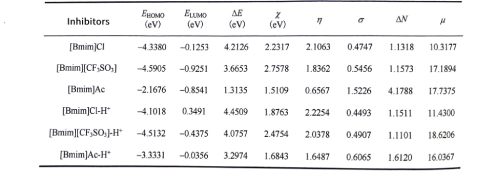
Verma et al. experimentally and computationally studied the adsorption behavior of three 1-butyl-3-methylimidazolium ionic liquids, namely 1-butyl-3-methylimidazolium chloride ([Bmim]CI), 1-butyl-3-methylimidazolium acetate ([Bmim]Ac) and 1-butyl-3-methylimidazolium trifluoromethanesulfonate ([Bmim][CF3SO3]) on the mild steel/1 mol·L-‘HC interface. The frontier molecular orbitals of the three ionic liquids studied were optimized by DFT. Table 4-1 lists the reactivity parameters calculated for the neutral and protonated forms of the studied ionic liquids. HOMO and LUMO energies (Enomo and ELumo, respectively) are measures of the tendency of electron-donating and electron-accepting inhibitor molecules. The results show that the EHoMo and ELuMo values of neutral and protonated inhibitors do not show any regular trend with the inhibition efficiency of the studied ionic liquids. The energy gap △E is a measure of the relative reactivity of the molecule. A lower AE indicates a high reactivity and vice versa. From the results, it can be seen that the ΔE values increase in the order of [Bmim]Ac<[Bmim][CF3SO3]<[Bmim]CI, which indicates that [Bmim]Ac is the most reactive among the three ionic liquids, which is consistent with the observed trend of corrosion inhibition efficiency.
Table 1 DFT parameters of neutral and protonated forms of (Bmim]CI, [Bmim][CF3SO3] and [Bmim]Ac molecules calculated using the B3LYP/6-31G(d) model
Xu et al. used the M06-2X and @B97XD methods and the 6-311++G (2d, p) basis set to study in detail the geometric structure, electronic structure, energetics and spectroscopic properties of different complexes formed by cytosine and imidazolium bromide ionic liquid [Cnmim]Br (n=2, 4, 6, 8, 10) molecules. According to the atom in molecule (AIM) theory, hydrogen bonds can be characterized by the presence of bond critical points (BCPs). The BCP and bond path of the structure Cnl at the M06-2X/6-311++G (2d.p) level are shown in Figure 8. The properties of the bonds between atoms can be characterized by the o value and the sign of the Laplace operator V2p of the electron density. Larger p values and negative V2o mean that the interatomic bonds exist in covalent formation. In contrast, low p values and positive V2p values usually refer to ionic bonds, H bonds or van der Waals interactions. In addition, there are three conditions for the existence of hydrogen bonds: ① the existence of BCP; ② the electron density p at the BCP of H·…Y is in the range of 0.002~0.035a.u.; ③ the corresponding Laplace operator V20 value falls in the range of 0.024~0.139a.u.

Figure 8 AIM diagram showing different bond critical points (BCPs) and bond paths of Cn1 calculated at the M06-2X/6-311++G(2d.p) level
BCP is indicated by orange dots
Zhuang et al. mixed two imidazolium chloride ILs with urea to dissolve chitosan. The two ionic liquids were [Amim]C1 and [Etmim]C1 [1-allyl-3-methyl-imidazolium chloride and 3-methyl-1 (ethylacetyl) imidazolium chloride]. They used chitosan (KET) as a structural model and used DFT calculations to discuss the interactions between ILs, urea and chitosan, and to elucidate the different physicochemical properties of ILs, urea and chitosan solutions. At the same time, DFT simulation results were used to illustrate the effects of different cationic substituents and urea addition on the dissolution of chitosan. Figure 9 shows the geometry and hydrogen bonding of pure ILs ([Amim]C1 and [Etmim]C1) and ILs-urea solutions optimized using DFT. Figure 10 reflects the hydrogen bonding between chitosan and [Etmim] C1 or [Amim] Cl and the hydrogen bonding between chitosan and [Etmim] Cl-urea or [Amim] Cl-urea.

Figure 10 Schematic diagram of hydrogen bonding between chitosan and [EtmimCl or [Amim]C1 and between chitosan and [Etmim]Cl-urea or [Amim]Cl-urea
DFT is a powerful quantum chemical method that can be used for corrosion inhibition studies, i.e., to relate molecular electronic parameters to their performance against corrosion on mild steel surfaces. Hajjaji et al. used electrochemical techniques and quantum chemical calculations to evaluate the performance of two pyridyl-based ionic liquids, (E)-4-(2-(4-fluorobenzyl)hydrazinecarbonyl)-1-propylpyridine-1-iodide (IPyr-C3Hz) and (E)-4-(2-(4-fluorobenzyl)hydrazinecarbonyl)-1-pentylpyridine-1-iodide (IPyr-CsH11), as novel inhibitors for mild steel corrosion in 1 mol·L-1IHC1, and used Gaussian 09 module based on B3LYP/6-311++G(dn) for DFT calculations to relate their adsorption patterns to various descriptions of the molecular structure, which can provide insights into the possible mechanisms between these inhibitors and the steel surface.
Figure 11 shows the optimized structures, HOMO and LUMO electron density distributions, and electrostatic potential surface (ESP) of the investigated ionic liquid molecules. IPyr-C3H7 and IPyr-C5H11 have almost the same HOMO density distribution, which is basically concentrated on the C=O bond, N—N bond and benzene ring attached to these molecules. On the other hand, for both inhibitors, the distribution of LUMO density is mainly located on the pyridazine motif. ESP is another form of understanding the electrophilic active sites in the molecular structure. From these ESP spectra, it can be seen that the electrophilic active sites of both compounds are located around the pyridazine atom and the carbon attached to the chlorine atom of this motif, which is shown as dark blue in the ESP spectra.

Figure 11 Optimized structure, HOMO and LUMO and ESP diagram of the neutral form of the compound under B3LYP/6-311G++(d,p)
At the same time, they also used MD simulation to evaluate the adsorption performance of two inhibitor molecules IPyr-C3H7 and IPyr-CsHu on the metallic Fe(110) surface. Figure 12 is a side view and a top view of the equilibrium adsorption patterns of the two inhibitor molecules on the Fe(110) surface at temperatures of 298K and 328K. The inhibitors at both studied temperatures were adsorbed on the Fe(110) surface in acidic medium through the entire molecular structure. The increase in temperature had no obvious effect on the adsorption configuration of the adsorbed inhibitor molecules. This adsorption behavior may occur due to the presence of several locally active electron donor-acceptor sites in the investigated inhibitor molecules, thereby enhancing the adsorption of these ILs on the steel surface.
Singh et al. studied the corrosion inhibition and adsorption properties of imidazoline-based ionic liquid 1-decyl-3-methylimidazolium chloride (DMIC) on P110 steel surface in 15% HCl under static and dynamic conditions. They used DFT to demonstrate that both the anion/cation moieties contribute to the adsorption of DMIC. Figure 13 shows the frontier molecular orbital distribution of neutral and protonated forms of DMIC optimized using DFT. The energy of the frontier molecular orbital (FMO) [including the highest occupied molecular orbital (HOMO), the lowest unoccupied molecular orbital (LUMO), and the energy gap (AE)] plays an important role in defining the reactivity of the molecule. The electron donating and accepting parts are controlled by the energies of the HOMC and LUMO, respectively. As can be seen from the figure, the cations in the neutral and protonated forms are concentrated on the imidazoline ring, which indicates that the anion part donates electrons in neutral and protonated forms, while the cation Some accept electrons. The comparison results of HOMO and LUMO energies show that the neutral form has a higher EHoMo than the protonated form. By comparing the electrochemical impedance parameters in Table 2, it can be seen that the neutral form has less EtuMo than the protonated form (Table 2). This indicates that the neutral form of DMIC has a greater adsorption tendency than the protonated form. Similarly, the energy gap (AE) of the neutral form is lower than that of the protonated form, showing a more neutral adsorption than the protonated form. Using MD, it was confirmed that the neutral DMIC was adsorbed flat on the P110 steel surface, while the protonated adsorption was distorted. In the neutral form, the DMIC molecules are adsorbed on the iron surface in a parallel manner. However, in the protonated form, DMIC is not adsorbed in a parallel manner. These configurations of the DMIC molecule result in a higher adsorption energy value (Ea) of the neutral form (-471.2 kcal·mol-1) than the protonated form (-396.61 kcal·mol-1). The high intensity of Eads confirms the stronger adsorption of the DMIC molecule on the iron surface.

Figure 12 Optimal adsorption structures of IPyr-C3Hz and IPyr-CsHn on Fe(110) surface at 298K and 328K

Figure 4-13 HOMO and LUMO images optimized using DFT

Table 2 Electrochemical impedance spectroscopy parameters of P110 steel in 15% HCl at 308K, different rotation speeds and optimal DMIC concentration (400 mg·L-1)
The accuracy of the exact Kohn-Sham density functional theory in MD simulations involves the size of the system, the number of molecules or molecular clusters to be evaluated, or the sampling efficiency. Kranz et al. combined the approximate DFT method with automatic machine learning, using large quantum chemical data sets for parameterization and effectively automating the parameterization process of DFT. The density functional tight binding method achieves a good balance between accuracy and computational efficiency. Huran et al. calculated the formation energy and the forces on the atoms under tight binding conditions, and the results reproduced with DFT can be used as the parameter set for calculating the fourth group of elements.
For more information about capacitors, please click: https: //xuanxcapacitor.com


